Bachelor en ingénierie
Énergétique et Environnementale
Le Bachelor en ingénierie Énergétique et Environnementale de l'EPF est une formation certifiée RNCP (n° 39550) (pour les admissions en 2ème et 3ème année) et conférant le grade de licence (admission en 1ère année) qui prépare aux métiers de l'ingénierie énergétique et de la gestion environnementale.
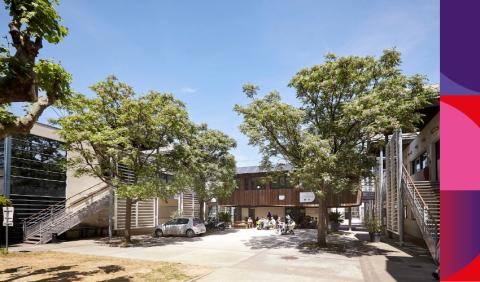
Dispensé sur le campus de Montpellier, ce programme forme des professionnels capables de concevoir, auditer et piloter des projets liés aux énergies renouvelables, à la transition écologique et à la performance énergétique des bâtiments et réseaux et s’appuie sur des moyens innovants, en particulier la plateforme laboratoire énergétique EnergyLab.
Programme
Le programme du Bachelor en ingénierie Énergétique et Environnementale s’adapte à l’année d’intégration de l’étudiant.
Les étudiants rejoignant le cursus dès la première année suivent un parcours progressif en anglais sur trois ans, des fondamentaux scientifiques à la spécialisation technique.
Pour une intégration directe en deuxième ou troisième année, le programme est en francais.
Programme sur 3 ans pour les admissions en 1ère année
Semester 1
Course Description: This mathematics course unit provides the essential mathematical and statistical foundations for engineering studies. Students develop skills in trigonometry, calculus, and differential equations. The course also introduces probability, statistical distributions, estimation, and hypothesis testing. These competencies support engineering analysis, modeling, quantitative problem solving, and data-driven decision-making, while preparing students for advanced engineering coursework and professional practice.
- # times this course can be taken for credit: 1
- Semester credit hours / ECTS’ credits: 10 / 12
- Grading system: ABCDF
- Mode of Delivery: Face to Face
- Language of instruction: English
Course Description: This science course unit provides the fundamental chemistry, physics, and electrical concepts needed for engineering studies. Students learn about atomic structure, chemical reactions, thermochemistry, motion, forces, and particle statics, as well as DC and AC electrical circuits. These principles support engineering problem-solving and establish a foundation for advanced engineering coursework.
- # times this course can be taken for credit: 1
- Semester credit hours / ECTS’ credits: 7 / 9
- Grading system: ABCDF
- Mode of Delivery: Face to Face
- Language of instruction: English
Course Description: This course focuses on digital engineering and develops the digital and programming skills essential for future engineers. Students gain proficiency in Microsoft Office tools as well as the fundamentals of computational thinking, algorithm design, and programming in Python. They learn to use variables, conditional structures, and loops to solve problems. These skills form the foundation for automation, data analysis, and advanced applications in digital engineering.
- Number of times this course can be taken and earn credits: 1
- Semester credit hours / ECTS Credits: 2 / 3
- Grading Scale: ABCDF
- Teaching Format: In-person
- Language of Instruction: English
Course Description: This course develops technical writing and communication skills in English, with an emphasis on clarity, structure, and adapting to different audiences. It also offers an introduction to French as a foreign language, covering the basics of vocabulary, grammar, and communication. Together, these courses strengthen technical and intercultural communication skills in an international engineering context.
- Number of times this course can be taken and earn credits: 1
- Semester credit hours / ECTS Credits: 5 / 4
- Grading Scale: ABCDF
- Teaching Format: In-person
- Language of Instruction: English
Course Description: This course provides design skills tailored to each specialization. In mechanical engineering, students develop their skills in graphic communication, CAD, technical drawing, and visualization methods. In electrical engineering and robotics, they learn the fundamentals of embedded systems, electronics, and microcontroller programming through the design of an autonomous mini-rover. Laboratory work and projects enable students to design, implement, and evaluate technical solutions specific to each field.
- Number of times this course can be taken and earn credits: 1
- Semester credit hours / ECTS Credits: 1 / 1
- Grading Scale: ABCDF
- Teaching Format: In-person
- Language of Instruction: English
Semestre 2
Course Description: This course develops the mathematical skills necessary for engineering modeling. Students study integral calculus, transcendental functions, sequences and series, as well as analytical geometry and linear algebra. The course also introduces differential equations for the analysis of dynamic systems.
- Number of times this course can be taken and earn credits: 1
- Semester credit hours / ECTS Credits: 7 / 9
- Grading Scale: ABCDF
- Teaching Format: In-person
- Language of Instruction: English
Course Description: This course introduces the fundamental principles of mechanics as applied to engineering. Students study Newton's laws, forces, motion, and oscillatory phenomena, including damping and resonance. These concepts enable students to analyze and model the behavior of physical systems in preparation for advanced studies in mechanics and engineering design.
- Number of times this course can be taken and earn credits: 1
- Semester credit hours / ECTS Credits: 4 / 4
- Grading Scale: ABCDF
- Teaching Format: In-person
- Language of Instruction: English
Course Description: This course introduces the fundamental principles of electrical and mechanical engineering through circuit analysis, statics, and strength of materials. These concepts provide the foundation for designing and evaluating engineering solutions.
- Number of times this course can be taken and earn credits: 1
- Semester credit hours / ECTS Credits: 9 / 10
- Grading Scale: ABCDF
- Teaching Format: In-person
- Language of Instruction: English
Course Description: This course develops future engineers’ communication skills, proficiency in French as a foreign language, and professional competence. Students also explore ethics, professional responsibility, sustainable development, and social responsibility in order to communicate effectively and act responsibly in an international context.
- Number of times this course can be taken and earn credits: 1
- Semester credit hours / ECTS Credits: 5 / 5
- Grading Scale: ABCDF
- Teaching Format: In-person
- Language of Instruction: English
Course Unit Description: This course unit develops applied design skills in mechanical engineering, electrical engineering, and robotics. Students explore CAD, control systems, and systems integration through hands-on projects that strengthen engineering design and problem-solving abilities.
- Number of times this course can be taken and earn credits: 1
- Semester credit hours / ECTS Credits: 2 / 2
- Grading Scale: ABCDF
- Teaching Format: In-person
- Language of Instruction: English
Course Unit Description: This course unit develops applied design skills in mechanical, electrical, and robotics engineering. Students carry out hands-on projects that enable them to design, integrate, and evaluate engineering systems while strengthening their problem-solving abilities.
- Number of times this course can be taken and earn credits: 1
- Semester credit hours / ECTS Credits: 3 / 3
- Grading Scale: ABCDF
- Teaching Format: In-person
- Language of Instruction: English
Semestre 3
Course Unit Description: This unit covers multivariable calculus (partial derivatives, multiple integrals, and vector analysis) as well as linear algebra (eigenvalues, eigenvectors, and diagonalization), with applications in engineering.
- Number of times this course can be taken and earn credits: 1
- Semester credit hours / ECTS Credits: 6 / 5
- Grading Scale: ABCDF
- Teaching Format: In-person
- Language of Instruction: English
Course Unit Description: This course introduces the fundamental principles of electromagnetism, including electric and magnetic fields, electromagnetic induction, and Maxwell's equations, which form the basis of electrical and electronic technologies.
- Number of times this course can be taken and earn credits: 1
- Semester credit hours / ECTS Credits: 4 / 4
- Grading Scale: ABCDF
- Teaching Format: In-person
- Language of Instruction: English
Course Unit Description: This course unit provides the foundations of fluid mechanics, structural mechanics, and applied scientific computing. Students learn to model and analyze engineering systems, evaluate their behavior under load, and numerically solve technical problems using algorithms and programming tools.
- Number of times this course can be taken and earn credits: 1
- Semester credit hours / ECTS Credits: 11 / 10
- Grading Scale: ABCDF
- Teaching Format: In-person
- Language of Instruction: English
Course Unit Description: This course unit strengthens professional communication skills, French as a foreign language, and preparation for professional integration. Students develop fluency in written and spoken communication, as well as the interpersonal skills expected in academic and industry environments.
- Number of times this course can be taken and earn credits: 1
- Semester credit hours / ECTS Credits: 3 / 3
- Grading Scale: ABCDF
- Teaching Format: In-person
- Language of Instruction: English
Course Unit Description: This course unit offers two specialization tracks. The Mechanical (ME) track focuses on materials science and the fundamental principles of thermodynamics applied to energy systems. The Electrical (EE) track focuses on instrumentation, control, and energy management through the development and optimization of a standalone electrical system.
- Number of times this course can be taken and earn credits: 1
- Semester credit hours / ECTS Credits: 6 / 5
- Grading Scale: ABCDF
- Teaching Format: In-person
- Language of Instruction: English
Course Unit Description: This course unit strengthens applied design skills in mechanical, electrical, and robotics engineering. Through hands-on projects, students design, integrate, and evaluate engineering systems while developing their ability to solve complex problems.
- Number of times this course can be taken and earn credits: 1
- Semester credit hours / ECTS Credits: 3 / 3
- Grading Scale: ABCDF
- Teaching Format: In-person
- Language of Instruction: English
The following courses, or equivalent, must be completed abroad at a recognized higher education institution. Preference will be given to institutions offering ABET-accredited BSME, BSEE, or BSE programs, and, where possible, to universities located in the United States. For non-partner institutions, course selection must be submitted for prior approval by an academic advisor
Semestre 4
Course Unit Description: This course unit covers the kinematics and dynamics of rigid bodies, including work, energy, impulse, and momentum in two and three dimensions, with applications to mechanical and aerospace systems.
- Number of times this course can be taken and earn credits: 1
- Semester credit hours / ECTS Credits: 3 / 6
- Grading Scale: ABCDF
- Teaching Format: In-person
- Language of Instruction: English
Course Unit Description: This course unit develops the transversal skills essential to academic and professional success. It combines professional communication and French as a foreign language with activities in sport, art, or music that foster creativity, personal expression, teamwork, and well-being.
- Number of times this course can be taken and earn credits: 1
- Semester credit hours / ECTS Credits: 6 / 11
- Grading Scale: ABCDF
- Teaching Format: In-person
- Language of Instruction: English
Course Unit Description: This course unit offers two specialization tracks. The Mechanical (ME) track focuses on materials, manufacturing processes, and machine design. The Electrical (EE) track covers control systems, electronics, and electrical machines through theoretical and experimental activities.
- Number of times this course can be taken and earn credits: 1
- Semester credit hours / ECTS Credits: 7 / 13
- Grading Scale: ABCDF
- Teaching Format: In-person
- Language of Instruction: English
Semestre 5
Course Unit Description: This course unit develops the skills needed for innovation and professional integration. It covers the fundamentals of economics and entrepreneurship applied to engineering, as well as further development of French language skills in an academic and professional context.
- Number of times this course can be taken and earn credits: 1
- Semester credit hours / ECTS Credits: 7 / 10
- Grading Scale: ABCDF
- Teaching Format: In-person
- Language of Instruction: English
Course Unit Description: This course unit offers two specialization tracks. The Mechanical (ME) track covers finite element modeling and heat transfer. The Electrical (EE) track focuses on drone systems, from flight control to autonomous navigation.
- Number of times this course can be taken and earn credits: 1
- Semester credit hours / ECTS Credits: 6 / 9
- Grading Scale: ABCDF
- Teaching Format: In-person
- Language of Instruction: English
Course Unit Description: This course unit represents
the culmination of the curriculum through a Senior Design Capstone project and a research project in either the Mechanical (ME) or Electrical (EE) track. Students draw on the knowledge they have acquired to design, develop, and evaluate an innovative engineering solution, while being introduced to research methods and technical communication.
- Number of times this course can be taken and earn credits: 1
- Semester credit hours / ECTS Credits: 6 / 11
- Grading Scale: ABCDF
- Teaching Format: In-person
- Language of Instruction: English
Semestre 6
Course Unit Description: This course unit consists of a six-month internship in a company or research laboratory. Students put their technical and professional skills into practice in a real-world environment, while developing their autonomy, analytical skills, and understanding of the challenges of engineering and innovation.
- Number of times this course can be taken and earn credits: 1
- Semester credit hours / ECTS Credits: 6 / 30
- Grading Scale: ABCDF Teaching Format: In-person
- Language of Instruction: English
Programme pour les admissions en 2ème ou 3ème année
- Conversion de l'énergie
- Bâtiment
- Simulation thermique
- Dynamique
- Transition énergétique environnementale et numérique
- Énergies renouvelables
- Supervision et hypervision
- Anglais
- Éco-conception
- RSE
- Apporter une solution à un besoin énergétique
- Piloter la maintenance préventive et corrective d'une installation
- Assurer un suivi de projet dans le respect des réglementations environnementales
- Mettre en place, analyser et exploiter des données issues d'un système de supervision
La troisième année se déroule en alternance, à raison de 36 semaines en entreprise, 16 semaines en formation avec quatre périodes de quatre semaines à l'EPF.
À l'issue du bachelor et sous condition de niveau, les diplômés ont la possibilité de rejoindre le programme Ingénieur de l'EPF.
- Titulaires d'un bac général avec spécialités scientifiques (mathématiques, physique-chimie, SVT, SI, NSI)
- Titulaires d'un bac technologique STI2D, STMG ou STL
- Titulaires d'un bac professionnel avec un dossier solide
- Étudiants en réorientation ou poursuite d'études : CPGE, PASS/LAS, BTS, BUT, licence scientifique, licence technologique ou école d'ingénieurs
- Travailler dans la gestion de projets énergétiques et environnementaux
- Développer une expertise en énergies renouvelables, économie circulaire ou RSE
- Obtenir un diplôme reconnu permettant un accès rapide à l'emploi ou une poursuite d'études en école d'ingénieur
Comment candidater ?
- Inscription sur parcoursup.fr en suivant la procédure du Concours Avenir Bac - Programme Bachelors avant le 13 mars 2026.
- Étude du dossier scolaire de terminale et première.
- Si admissible, entretien de motivation (courant avril).
Les frais de candidature sont de 30 € (gratuit pour les boursiers) quel que soit le nombre d’écoles choisies.
Les candidatures sont ouvertes aux étudiants de : Bachelor, BTS, BUT, école d’ingénieur, LAS, PASS, licence, math sup, math spé, ATS (non exhaustif)
Inscription via le Concours AvenirPlus à partir du 8 décembre.
- Les dossiers sont étudiés par le responsable pédagogique de la formation et les candidats admissibles sont convoqués à un entretien.
- Convocation à un entretien pour les étudiants admissibles.
- Les propositions d'admission sont faites au fil de l'eau, visibles sur AvenirPlus.
Les frais de candidatures pour le programme Bachelor sont de 35€ (gratuits pour les boursiers).
Modalités de la formation
Les frais de scolarité du Bachelor EPF sont de
- 7 636 € par an pour les admission en 2ème ou 3ème année (la troisième année, réalisée en apprentissage, est intégralement financée par l'entreprise d'accueil.)
- 10 000 € par an pour les admissions en première année qui réalisent le cycle complet de 3 ans.
Taux de diplomation : 100%
Titre RNCP 39550
l’EPF s’engage en faveur de l’inclusion et de la diversité de ses étudiants.

Carrière & débouchés
- Réseaux d’énergie et de fluides
- Énergies renouvelables
- Réseaux intelligents
- Industries
- Bâtiment
- Assistant ingénieur de Bureau d'Études ou d'exploitation ;
- Consultant Énergie et Environnement ;
- Auditeurs de réseaux et de systèmes énergétiques ;
- Chef de projet junior
Poursuite d'études et reconnaissance du diplôme
Le Bachelor en ingénierie Énergétique et Environnementale délivre un diplôme de niveau Bac+3 enregistré au RNCP (n° 39550) et conférant le grade de licence. Il est délivré par l'EPF, école d'ingénieurs reconnue par la Commission des Titres d'Ingénieur (CTI).
Le Bachelor est un diplôme conférant le grade de licence. Toutefois, une intégration directe en deuxième ou troisième année permet d’obtenir uniquement le titre RNCP de niveau 6 (Bac+3), et non le grade de licence.
Ce que signifie cette reconnaissance : Le grade de licence permet une équivalence dans l'espace européen de l'enseignement supérieur (processus de Bologne). La certification RNCP garantit que les compétences du diplômé répondent à un référentiel professionnel validé par l'État. Cela facilite aussi bien l'insertion professionnelle que la candidature en master ou cycle ingénieur.
Contacts



Foire aux questions (FAQ)
Un bac général avec des spécialités scientifiques est recommandé. Les bacs technologiques STI2D, STMG et STL sont également acceptés, ainsi que les bacs professionnels avec un bon dossier.
Oui. Il est enregistré au RNCP (n° 39550) et confère le grade de licence, délivré par une école habilitée par la CTI. Toutefois, une intégration directe en deuxième ou troisième année permet d’obtenir uniquement le titre RNCP de niveau 6 (Bac+3), et non le grade de licence.
- 7 636 € par an pour les admission en 2ème ou 3ème année (la troisième année, réalisée en apprentissage, est intégralement financée par l'entreprise d'accueil.)
- 10 000 € par an pour les admissions en première année qui réalisent le cycle complet de 3 ans.
Oui, les diplômés peuvent accéder au cycle ingénieur EPF sous conditions. Les critères précis sont à confirmer avec l'école.